 Add to Chrome
 Add to Firefox
 Add to Edge
MobEvolve: An Agentic Self-Evolving Heuristic System for Interpretable Human Mobility Generation
Jun 01, 2026
Human mobility generation aims to synthesize realistic trip chains for target populations based on individual features. Existing paradigms, including deep generative models, LLM-based methods, and traditional heuristics, struggle to satisfy the complex demands of this task while simultaneously maintaining interpretability, behavioral plausibility, population-level distributional alignment, and inference efficiency. To bridge this gap, we introduce MobEvolve, the first agentic self-evolving heuristic framework for human mobility generation. MobEvolve initializes a behavior-inspired heuristic system and employs an LLM agent to iteratively evolve its internal logic. By diagnosing empirical misalignments and failure cases on a validation set, the agent proposes targeted updates and accumulates evolution memory for cumulative self-improvement. Extensive evaluations on the Singapore and Montreal benchmarks demonstrate that MobEvolve significantly outperforms state-of-the-art deep generative and LLM-based methods in individual trajectory fidelity, population-level distribution alignment, and behavioral plausibility, while preserving interpretability and high inference efficiency.

FrontierOR: Benchmarking LLMs' Capacity for Efficient Algorithm Design in Large-Scale Optimization
May 26, 2026Large language models (LLMs) are increasingly used for optimization modeling and solver-code generation, yet practical operations research and optimization problems often require a harder capability: designing scalable algorithms that exploit problem structure and outperform direct formulation-and-solve baselines. Existing benchmarks are limited to small or simplified examples far below real-world scale and complexity. We introduce FrontierOR, among the first benchmarks to systematically evaluate LLM-based efficient algorithm design for realistic large-scale optimization problems. FrontierOR includes 180 tasks derived from methodologically diverse papers published in top-tier operations research venues, each with standardized instances and a hidden, expert-verified evaluation suite. We evaluate seven LLMs spanning frontier, cost-effective, and open-source models both in one-shot and test-time evolution settings. The results reveal that frontier models still struggle to move from executable formulations to efficient optimization algorithms: the strongest one-shot model outperforms Gurobi in only 31% of cases in both solution quality and computational efficiency, and even strong coding agents with test-time evolution achieve only 50% on selected hard tasks. FrontierOR establishes a practical evaluation platform for LLM-based optimization algorithm design, which enables future LLMs and agents to be systematically tested on whether they can move beyond correct formulation toward a feasible, high-quality, and efficient algorithm.
DecisionBench: A Benchmark for Emergent Delegation in Long-Horizon Agentic Workflows
May 18, 2026We introduce DecisionBench, a benchmark substrate for emergent delegation in long-horizon agentic workflows. The substrate fixes a task suite (GAIA, tau-bench, BFCL multi-turn), a peer-model pool (11 models, 7 vendor families), a delegation interface (call_model plus an optional read_profile channel), a deterministic skill-annotation layer, and a multi-axis metric suite covering quality, cost, latency, delegation rate, routing fidelity-at-k, vendor self-preference, and a counterfactual-delegation ceiling. The substrate is agnostic to how peer information is generated or delivered, so learned routers, richer peer memories, adaptive profile construction, and multi-step delegation can all be evaluated against it. We characterize the substrate with a five-condition reference sweep on the full pool (n=23,375 task instances). Three benchmark-level findings emerge: (i) mean end-task quality is statistically indistinguishable across the four awareness conditions (|beta| <= 0.010, p >= 0.21), so quality-only evaluation would miss the orchestration signal; (ii) routing fidelity-at-1 ranges from 7.5% to 29.5% across conditions at near-equal mean quality, with delivery channel (on-demand tool vs. preloaded description) dominating description content; (iii) a counterfactual ceiling places perfect delegation 15-31 percentage points above measured performance on every suite, locating large unrealized headroom for future orchestration methods. We release the substrate, annotation layer, reference intervention suite, analysis pipeline, and 220 per-condition run archives.
The Last Human-Written Paper: Agent-Native Research Artifacts
Apr 27, 2026Scientific publication compresses a branching, iterative research process into a linear narrative, discarding the majority of what was discovered along the way. This compilation imposes two structural costs: a Storytelling Tax, where failed experiments, rejected hypotheses, and the branching exploration process are discarded to fit a linear narrative; and an Engineering Tax, where the gap between reviewer-sufficient prose and agent-sufficient specification leaves critical implementation details unwritten. Tolerable for human readers, these costs become critical when AI agents must understand, reproduce, and extend published work. We introduce the Agent-Native Research Artifact (Ara), a protocol that replaces the narrative paper with a machine-executable research package structured around four layers: scientific logic, executable code with full specifications, an exploration graph that preserves the failures compilation discards, and evidence grounding every claim in raw outputs. Three mechanisms support the ecosystem: a Live Research Manager that captures decisions and dead ends during ordinary development; an Ara Compiler that translates legacy PDFs and repos into Aras; and an Ara-native review system that automates objective checks so human reviewers can focus on significance, novelty, and taste. On PaperBench and RE-Bench, Ara raises question-answering accuracy from 72.4% to 93.7% and reproduction success from 57.4% to 64.4%. On RE-Bench's five open-ended extension tasks, preserved failure traces in Ara accelerate progress, but can also constrain a capable agent from stepping outside the prior-run box depending on the agent's capabilities.
CORAL: Towards Autonomous Multi-Agent Evolution for Open-Ended Discovery
Apr 02, 2026Large language model (LLM)-based evolution is a promising approach for open-ended discovery, where progress requires sustained search and knowledge accumulation. Existing methods still rely heavily on fixed heuristics and hard-coded exploration rules, which limit the autonomy of LLM agents. We present CORAL, the first framework for autonomous multi-agent evolution on open-ended problems. CORAL replaces rigid control with long-running agents that explore, reflect, and collaborate through shared persistent memory, asynchronous multi-agent execution, and heartbeat-based interventions. It also provides practical safeguards, including isolated workspaces, evaluator separation, resource management, and agent session and health management. Evaluated on diverse mathematical, algorithmic, and systems optimization tasks, CORAL sets new state-of-the-art results on 10 tasks, achieving 3-10 times higher improvement rates with far fewer evaluations than fixed evolutionary search baselines across tasks. On Anthropic's kernel engineering task, four co-evolving agents improve the best known score from 1363 to 1103 cycles. Mechanistic analyses further show how these gains arise from knowledge reuse and multi-agent exploration and communication. Together, these results suggest that greater agent autonomy and multi-agent evolution can substantially improve open-ended discovery. Code is available at https://github.com/Human-Agent-Society/CORAL.
OmniSapiens: A Foundation Model for Social Behavior Processing via Heterogeneity-Aware Relative Policy Optimization
Feb 11, 2026To develop socially intelligent AI, existing approaches typically model human behavioral dimensions (e.g., affective, cognitive, or social attributes) in isolation. Although useful, task-specific modeling often increases training costs and limits generalization across behavioral settings. Recent reasoning RL methods facilitate training a single unified model across multiple behavioral tasks, but do not explicitly address learning across different heterogeneous behavioral data. To address this gap, we introduce Heterogeneity-Aware Relative Policy Optimization (HARPO), an RL method that balances leaning across heterogeneous tasks and samples. This is achieved by modulating advantages to ensure that no single task or sample carries disproportionate influence during policy optimization. Using HARPO, we develop and release Omnisapiens-7B 2.0, a foundation model for social behavior processing. Relative to existing behavioral foundation models, Omnisapiens-7B 2.0 achieves the strongest performance across behavioral tasks, with gains of up to +16.85% and +9.37% on multitask and held-out settings respectively, while producing more explicit and robust reasoning traces. We also validate HARPO against recent RL methods, where it achieves the most consistently strong performance across behavioral tasks.
Position: Simulating Society Requires Simulating Thought
Jun 08, 2025Simulating society with large language models (LLMs), we argue, requires more than generating plausible behavior -- it demands cognitively grounded reasoning that is structured, revisable, and traceable. LLM-based agents are increasingly used to emulate individual and group behavior -- primarily through prompting and supervised fine-tuning. Yet they often lack internal coherence, causal reasoning, and belief traceability -- making them unreliable for analyzing how people reason, deliberate, or respond to interventions. To address this, we present a conceptual modeling paradigm, Generative Minds (GenMinds), which draws from cognitive science to support structured belief representations in generative agents. To evaluate such agents, we introduce the RECAP (REconstructing CAusal Paths) framework, a benchmark designed to assess reasoning fidelity via causal traceability, demographic grounding, and intervention consistency. These contributions advance a broader shift: from surface-level mimicry to generative agents that simulate thought -- not just language -- for social simulations.
Reimagining Urban Science: Scaling Causal Inference with Large Language Models
Apr 15, 2025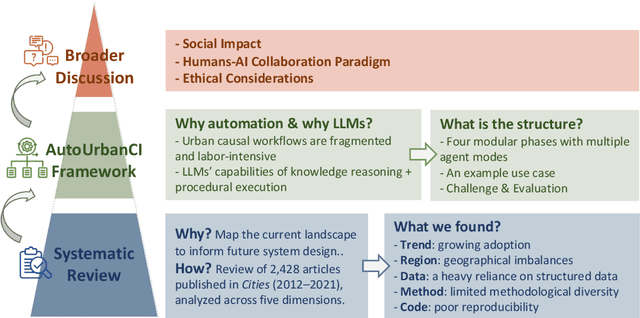
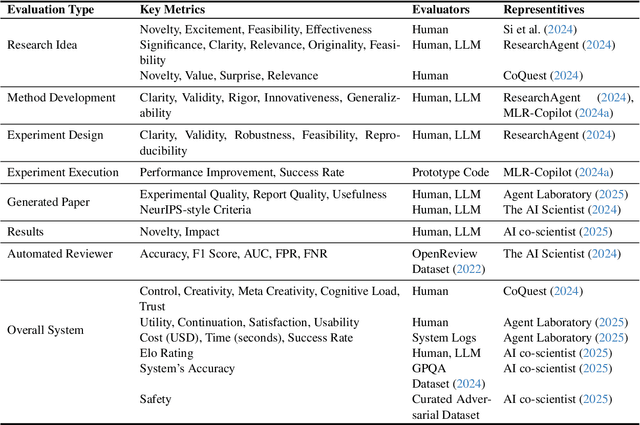
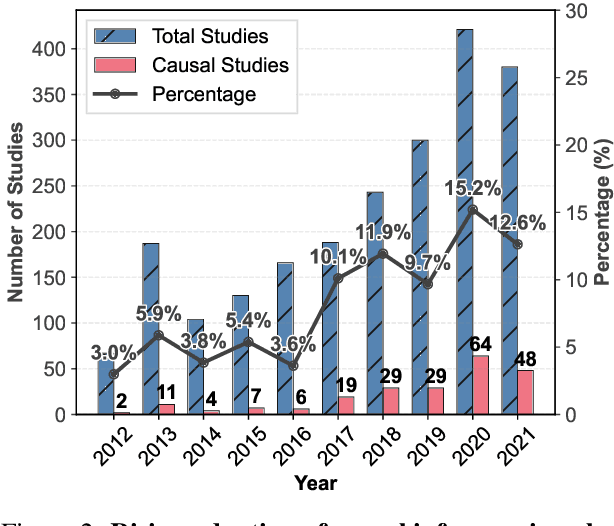
Urban causal research is essential for understanding the complex dynamics of cities and informing evidence-based policies. However, it is challenged by the inefficiency and bias of hypothesis generation, barriers to multimodal data complexity, and the methodological fragility of causal experimentation. Recent advances in large language models (LLMs) present an opportunity to rethink how urban causal analysis is conducted. This Perspective examines current urban causal research by analyzing taxonomies that categorize research topics, data sources, and methodological approaches to identify structural gaps. We then introduce an LLM-driven conceptual framework, AutoUrbanCI, composed of four distinct modular agents responsible for hypothesis generation, data engineering, experiment design and execution, and results interpretation with policy recommendations. We propose evaluation criteria for rigor and transparency and reflect on implications for human-AI collaboration, equity, and accountability. We call for a new research agenda that embraces AI-augmented workflows not as replacements for human expertise but as tools to broaden participation, improve reproducibility, and unlock more inclusive forms of urban causal reasoning.
Sparkle: Mastering Basic Spatial Capabilities in Vision Language Models Elicits Generalization to Composite Spatial Reasoning
Oct 21, 2024Vision language models (VLMs) have demonstrated impressive performance across a wide range of downstream tasks. However, their proficiency in spatial reasoning remains limited, despite its crucial role in tasks involving navigation and interaction with physical environments. Specifically, much of the spatial reasoning in these tasks occurs in two-dimensional (2D) environments, and our evaluation reveals that state-of-the-art VLMs frequently generate implausible and incorrect responses to composite spatial reasoning problems, including simple pathfinding tasks that humans can solve effortlessly at a glance. To address this, we explore an effective approach to enhance 2D spatial reasoning within VLMs by training the model on basic spatial capabilities. We begin by disentangling the key components of 2D spatial reasoning: direction comprehension, distance estimation, and localization. Our central hypothesis is that mastering these basic spatial capabilities can significantly enhance a model's performance on composite spatial tasks requiring advanced spatial understanding and combinatorial problem-solving. To investigate this hypothesis, we introduce Sparkle, a framework that fine-tunes VLMs on these three basic spatial capabilities by synthetic data generation and targeted supervision to form an instruction dataset for each capability. Our experiments demonstrate that VLMs fine-tuned with Sparkle achieve significant performance gains, not only in the basic tasks themselves but also in generalizing to composite and out-of-distribution spatial reasoning tasks (e.g., improving from 13.5% to 40.0% on the shortest path problem). These findings underscore the effectiveness of mastering basic spatial capabilities in enhancing composite spatial problem-solving, offering insights for improving VLMs' spatial reasoning capabilities.
IntersectionZoo: Eco-driving for Benchmarking Multi-Agent Contextual Reinforcement Learning
Oct 19, 2024Despite the popularity of multi-agent reinforcement learning (RL) in simulated and two-player applications, its success in messy real-world applications has been limited. A key challenge lies in its generalizability across problem variations, a common necessity for many real-world problems. Contextual reinforcement learning (CRL) formalizes learning policies that generalize across problem variations. However, the lack of standardized benchmarks for multi-agent CRL has hindered progress in the field. Such benchmarks are desired to be based on real-world applications to naturally capture the many open challenges of real-world problems that affect generalization. To bridge this gap, we propose IntersectionZoo, a comprehensive benchmark suite for multi-agent CRL through the real-world application of cooperative eco-driving in urban road networks. The task of cooperative eco-driving is to control a fleet of vehicles to reduce fleet-level vehicular emissions. By grounding IntersectionZoo in a real-world application, we naturally capture real-world problem characteristics, such as partial observability and multiple competing objectives. IntersectionZoo is built on data-informed simulations of 16,334 signalized intersections derived from 10 major US cities, modeled in an open-source industry-grade microscopic traffic simulator. By modeling factors affecting vehicular exhaust emissions (e.g., temperature, road conditions, travel demand), IntersectionZoo provides one million data-driven traffic scenarios. Using these traffic scenarios, we benchmark popular multi-agent RL and human-like driving algorithms and demonstrate that the popular multi-agent RL algorithms struggle to generalize in CRL settings.